Screen Time: How Jordan Silhouettes Became UK Music Video's Loudest Quiet Signal
Photo: micadew, CC BY-SA 2.0, via Wikimedia Commons
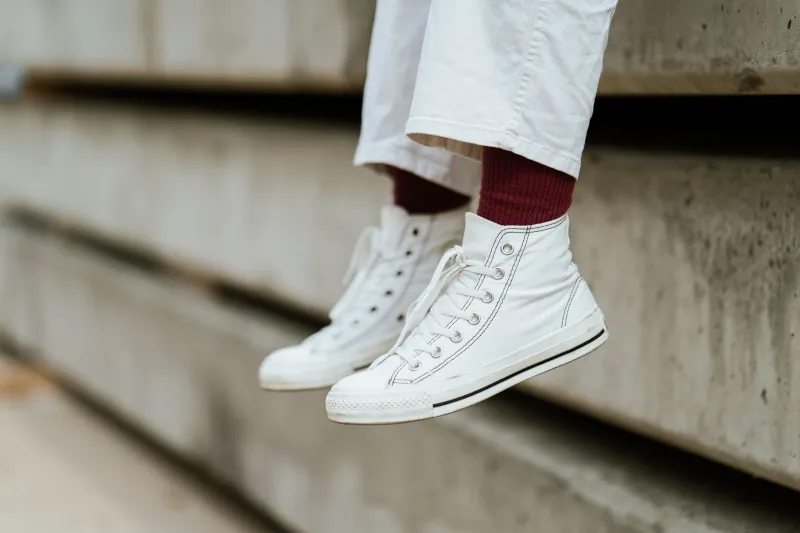
There's a shot you've seen a hundred times without registering it. A rapper stepping out of a car, camera low, and the frame holds for maybe a second and a half on the feet. It's not an accident. It's never an accident. In UK music video grammar, the shoe is a caption.
Jordans have been part of that grammar since the format had a budget. What's changed in 2026 is how deliberate it's become — and how quickly a two-second shot turns into a resale spike in Leicester, Glasgow and Peckham the same weekend.
The DVD era: proof over production
Start with the grime DVDs of the early 2000s. Risky Roadz, Practice Hours, Lord of the Mics — scrappy, handheld, shot on estates and in stairwells with whatever camera was going. Nobody had a stylist. What people wore was what they had, and what they had was a statement.
You can read those DVDs as an archive of aspiration. The trainers in those frames were bought with wages, saved for, worn carefully and cleaned obsessively. A pair of Jordans in a 2004 corridor freestyle wasn't a sponsored placement; it was evidence. It told the viewer that this person had money coming in, or had prioritised the right things, or both. In a scene obsessed with authenticity, the shoe was the least arguable proof of all.
That's the root of the UK relationship with the silhouette. In the US, Jordans arrived with a basketball lineage attached. Here, they arrived as a fashion object first and a sports one second. The music gave them a context that had nothing to do with a court.
Drill and the close-up
When drill visuals took over in the late 2010s, the camera got braver. Wide lenses, low angles, faces half-hidden. And the feet became a recurring motif — not because anyone sat down and decided it should be, but because the framing demanded it. When you can't show a face, you show a uniform.
The footwear in those videos did something subtle. It communicated region. Different cities, different boroughs, different crews settled into recognisable preferences — a particular silhouette, a particular colourway, a particular way of lacing that made a pair legible from twenty feet away. For viewers outside those areas, it became a kind of visual dialect.
It also created a styling template that leaked straight out of the screen and onto the pavement. The drill formula — slim or straight trouser, clean top, immaculate trainer — was essentially a British translation of a look that had been building for years. It valued tidiness over volume. No sagging. No scuffing. Nothing on show that hadn't been thought about.
The stylist's view
Amara Boateng, a London-based stylist who has worked on UK rap and R&B shoots for the past six years, says the conversation in the room has shifted.
'In 2019 the request was always the loudest pair available,' she says. 'Now artists come in with a mood board and half of it is quiet. They want the shoe to do work without announcing itself. The silhouettes that photograph well in a low light, with a flash, on a concrete stairwell — that's the whole game. It's not about price. It's about how the leather reads on camera.'
Boateng is blunt about where the influence flows. 'The videos don't follow the shops. The shops follow the videos. I've had calls from buyers asking what we used because they've seen the clip. It moves in about a week.'
What actually moves the resale needle
The mechanics are simple and slightly depressing. A video lands on a Friday. Clips circulate on the timeline. By Saturday night, search volume on secondhand platforms has jumped. By Monday, prices on the mid-tier pairs have crept up, and the ones that were sitting at a reasonable number are suddenly 'rare'.
The pairs that shift are rarely the grails. It's the mid-level, still-available colourways that see the biggest movement, because they're the ones a viewer can actually find and afford. High-end pairs spike in price but barely change hands; accessible pairs sell out of every size in a week. That's the strange economy of the screen.
There's also a feedback loop with styling. A silhouette gets screen time, it gets worn on the street, it gets photographed on the street, and then it appears in the next round of videos. After a couple of cycles, nobody remembers which came first.
Nostalgia as a colourway
What's happening in 2026 has a different flavour, though. A generation that grew up watching those DVDs and early videos is now making music itself, and the footwear in their visuals is often a callback. Mid-2000s shapes. Retros of retros. Pairs that read as a reference to something rather than a flex.
That nostalgia isn't decorative. It's a way of claiming lineage in a scene that prizes knowing your history. Wearing a specific silhouette in a specific colourway is a nod — a way of saying you were paying attention, or that someone older in your family was.
UK R&B and the more melodic end of rap have taken the idea further, leaning on softer palettes and low-tops to match a moodier visual register. The result is that the shoe no longer has to be loud to be a status object. Restraint has become its own flex.
The pavement effect
Walk through any UK city centre this winter and you can see the translation happening in real time. The screen look has been softened for daily life — a slightly wider trouser, a heavier coat, a bag that can take the weather. But the logic is intact: clean shoe, considered proportion, nothing accidental.
That's what makes the music video such an effective style engine. It's not selling a product; it's demonstrating a way of putting an outfit together. And unlike a lookbook, it's made by people who actually get dressed in the morning.
So next time a video holds on a pair of feet for a beat too long, don't skip it. That's the UK styling conversation happening in public — and by the following weekend, it'll be on a high street near you.